Uncategorized

Visualising competition in the Premier League and La Liga

Apologies, it’s taken me far too long to get round to writing this.

A little while ago, I set up a quiz to see whether people could accurately guess whether a spatially-plotted league table was from the Premier League or La Liga. The idea was to see if the (British) stereotype of the Premier League being competitive and La Liga being Barcelona and Real Madrid plus eighteen others was born out by the league tables. I did this because I’m pretty bored of reading comments like this:

“Right, yeah, English teams are bobbins in the Champions League because the Premier League might not have the highest quality, but it’s the best league in the world because of the competition and how close all the teams are. You never know who’s going to win it! It’s not like in Spain, where it’s always going to be Barcelona or Real Madrid winning it by a mile, and all the other teams don’t even matter.”

According to this stereotype, a spatial dotplot of the Premier League would look like this:

premier league stereotype

…while a spatial dotplot of La Liga would look like this:

la liga stereotype

So, I did what any reasonable person would do; I scraped a load of data, visualised the league tables as dotplots in random order, and created an online quiz to see if people could guess which league was which. If the differences between the two leagues are obvious, it should be easy enough to tell which league is which from a dotplot. The rest of this blog is basically a love letter to ggplot2.

People saw graphs like this, and simply had to say whether it was La Liga – Premier League or Premier League – La Liga:

League positions no lines no leagues 2008 classic

In this case, La Liga is on the left, and the Premier League is on the right. It’s the 2008-09 season, when Barcelona finished nine points ahead of Real Madrid and Manchester United finished four points ahead of Liverpool. The position of the league on the x-axis was shuffled, so that each league was on the left side and the right side five times each, and the questions were presented to people in a random order.

172 people did the quiz, and scored an average of 62%.

The most well-answered question was the 2011-12 season, where 74% of people correctly answered that La Liga is on the left and the Premier League is on the right:

League positions no lines leagues 2011 classic

…and the least well-answered question was the 2006-07 season, where only 35% of people correctly answered that La Liga is on the left and the Premier League is on the right:

League positions no lines leagues 2006 classic

This wasn’t a perfect psychology experiment. People doing the quiz already knew what it was about and were aware that I was looking into the stereotype, but it is a useful demonstration that it’s not easy to guess which league is which. Perhaps the stereotype isn’t entirely accurate. Indeed, if we take the ten seasons in the quiz plus the season just finished and do some descriptive statistics, the mean number of points in the Premier League is 52.1 and the mean number of points in La Liga is 52.4. while the standard deviation of points is 17.0 in the Premier League and 16.3 in La Liga. This would suggest that there’s no real difference in how widely the points are spread across the teams.

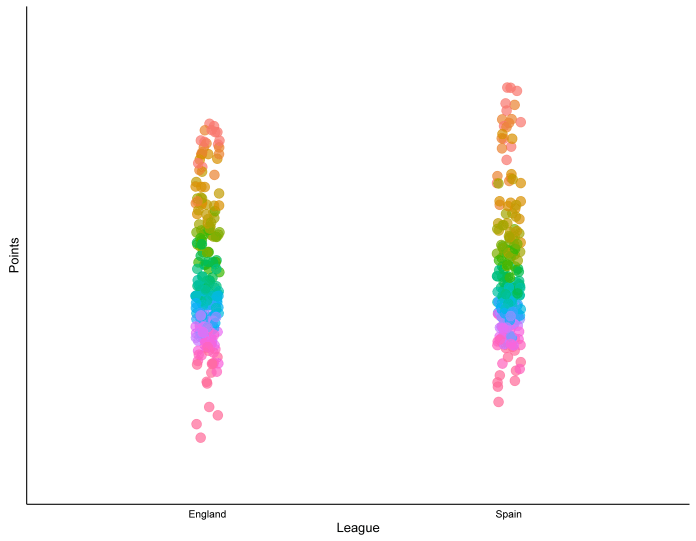
However, there might be a general trend when we look at all of them put together. If we take the ten seasons in the quiz, plus the season just finished, and plot the number of points per position per season, we get this graph:
League positions no lines leagues last 11 years classic

This actually does suggest that there may be something in the stereotype of the top teams in La Liga pulling away from the rest of the league. The dots at the top of the league are stretched higher than they are in the Premier League.

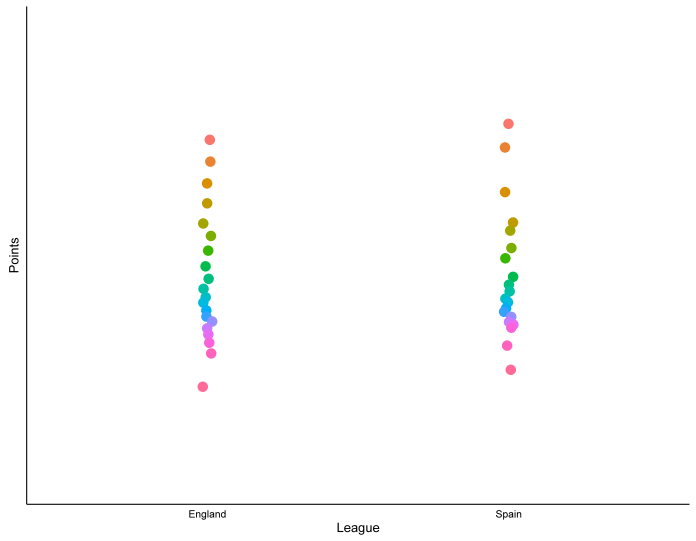
Similarly, we can look at the mean number of points per position in the last 11 seasons:
Mean league points per position no lines leagues last 11 years classic

…and this also seems to show that the top teams in La Liga are spread out a bit further than the top teams in the Premier League.

Sure enough, when we look at the stats for the top four teams, it shows a bit more spread; the mean number of points for the top four teams is very similar – 78.4 in the Premier League, 78.1 in La Liga – but the standard deviation is 8.2 in the Premier League and 12.1 in La Liga.

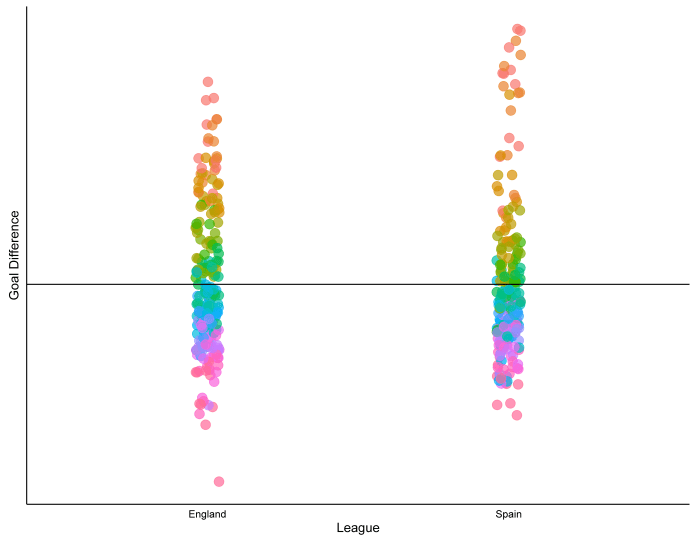
One last thing we can look at plotting is goal difference. Here’s the goal difference per position for each of the last 11 seasons (a goal difference of 0 is shown by the horizontal black line):
GD no lines leagues last 11 years classic

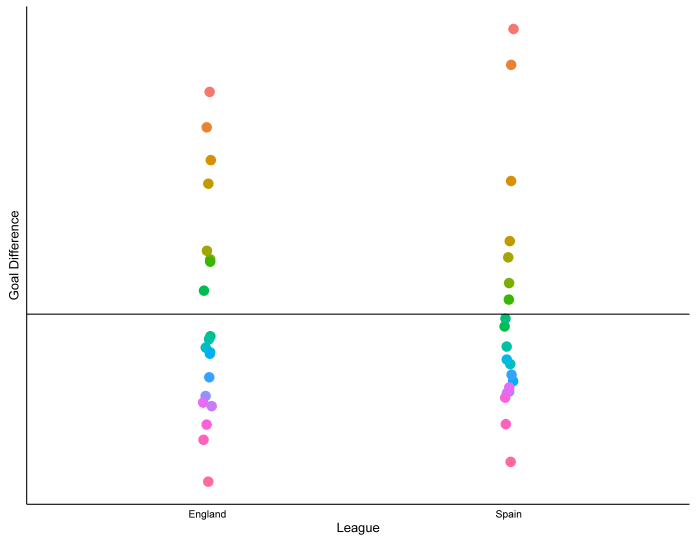
Again, the top teams in Spain seem to be more spread out compared to the rest of the league than the top teams in England are. In fact, when we average it together for the last 11 seasons, we get this:
Mean gd per position no lines leagues last 11 years classic

…which shows that, on average, the second-placed team in La Liga generally has a better goal difference than the winner of the Premier League (57.6 to 51.4), but that the third-placed team in La Liga generally has the same goal difference as the fourth-placed team in the Premier League (30.8 and 30.2 respectively).

How about combining these graphs, with points up the y-axis and goal difference denoted by dot size?

exaggerated mean pts and gd per position no lines leagues last 11 years classic

It seems that, on average, there may be some truth in the stereotype. The top two teams in La Liga dominate their competitors, both in terms of points and goal difference, whereas there seems to be less separating the top teams in the Premier League.

…and just for bonus points, let’s do the same thing for the top five European leagues over the last 11 seasons. This time it’s done by points per game rather than points, as the Bundesliga only has 18 teams:

exaggerated mean pts per game and gd per position no lines all five leagues last 11 years classic

It looks like the Premiership does have the most competitive title race after all.
Standard
Uncategorized

Dutch lessons for Brexit.

I don’t post political things. Not because I’m 26 and apathetic like much of my generation, but because most political shit I see is virtue-signalling rather than actual discussion, and I don’t want to contribute to that.

I’m making an exception today.

I’m British and I voted for the UK to stay in the EU. This wasn’t a difficult decision for me; while I do agree with some of the arguments about the problems of the EU, I don’t think that leaving the EU solves any of those problems. Thing is, though, this vote was never really about EU membership. It’s a domestic British revolution expressed through the wrong international forum.

It’s a strange experience to watch this develop from somewhere else. I live in the Netherlands, where everything is continuing as normal and I can’t get a sense of what the atmosphere in the UK is like. I’ve had a few pro-EU friends from home say things like “this fucking country, I’m so jealous you get to miss out on this” or “I bet you’re glad you’re outside the UK right now!”.

I’m not. I might be the kind of middle-class multilingual metropolitan lefty liberal prick that the anger of a lot of Brexit voters is directed against, but the UK is still my country, my culture, my people, and I hate seeing it tearing itself apart. I wish I was back there now. I think that people who say “I don’t like X, I’m moving to Y”, whether it’s Brits upping sticks because of Brexit, or Americans moving to Canada because of Trump, is sort of cowardly.

And funnily enough, this is something that living in the Netherlands for three years has taught me.

British people are fucking weird about being British. Vast swaths of the country are embarrassed about being British, and English doubly so. It’s not new either. George Orwell wrote about it in the 1940s:

England is perhaps the only great country whose intellectuals are ashamed of their own nationality. In left-wing circles it is always felt that there is something slightly disgraceful in being an Englishman and that it is a duty to snigger at every English institution, from horse racing to suet puddings. It is a strange fact, but it is unquestionably true that almost any English intellectual would feel more ashamed of standing to attention during “God Save the King” than of stealing from a poor box.

The longer I spend in the Netherlands, the more I realise how ridiculous this is. I’ve seen a lot of people writing a lot of things recently about how patriotism leads to division, how flying the British flag is the start of a slippery slope that leads to white people shouting at brown people to fuck off home. Three years ago, I’d have agreed, but it’s arse about face and it’s taken me moving to the Netherlands to see that.

We need small acts of patriotism, of banal nationalism, because it’s the small overt acts of patriotism that allow a country to positively define itself. More than that, the small communal acts of patriotism are actually tools for integration and inclusivity, not against; it’s a signal that says “hey, this is who we are, this is what we do, and taking part will make you welcomed and accepted”.

The Dutch get this. They’re a country comfortable in their own skin, or at least, far more so than the UK. On Koningsdag, the Dutch dress up in orange, sell second-hand shit in parks, and get drunk in an overt celebration of Dutchness in its boozy, thrifty, orange glory. Through British lenses, this should naturally develop into Dutch people laying out markers of what isn’t Dutch and excluding anybody who doesn’t fit, but it’s not, it doesn’t work like that. Small acts of patriotism through which Dutch identity and nationality is positively expressed allows people to integrate better. I stick on my two-stripe 1974 shirt and get drunk with Dutch people, and in doing so, this is me, an immigrant on benefits who doesn’t speak the language that well, taking the chance to show that I want to be part of this place, and in doing so, this is the Dutch accepting me. That’s not to say the Dutch don’t have their problems… but I’ve never seen a British Het land van.

Without this, how can an immigrant – especially an immigrant from a much more culturally distant background – integrate into the UK if we’re too embarrassed to show what being British actually means? If you’ve moved to a different country, you’re probably there because you want to be. Without a template for integration, a forum for showing your enthusiasm to be here, these tensions feel inevitable.

And it’s more than immigration. This atmosphere, this feeling, this communal gezelligheid of Dutchness, creates an atmosphere where Dutch people care about Dutch people more. I don’t think it’s a coincidence that the Netherlands has some of the lowest economic inequality in Europe. Meanwhile, think of the message that this embarrassment sends to a lot of British people whose lives are pretty shit – not only are we doing nothing to address your problems, we’re telling you that your national identity, which is pretty much all you have to hold on to, is something to be ashamed of.

I have a horrible feeling that we’re going to waste this crisis. Because it’s not just a crisis, it’s an opportunity, an opportunity for the real, far-reaching reform that we so desperately need. Many people who voted to leave the EU say that this is a fundamental issue of democracy. Brilliant. Let’s take that enthusiasm and establish a 21st century proportional voting system (fuck, I’d settle for a 20th century voting system, it’s still more up to date), and let’s get rid of the House of Lords. Watching everything unfold after this referendum, the fact that four million people voted UKIP last year and got one MP was a deafening sign of things to come. Many people who voted to leave the EU say that this is about reinvestment in our own people rather than supporting other countries. Not sure I agree, but fine, let’s fucking do that, let’s take this imaginary £350m a week and renationalise public services, build affordable council housing, extend the NHS, support British industry, and decentralise everything from London so that the rest of the country actually has stuff to do.

This is Caroline Lucas’ time. If she can run with the Green party’s current policies and acknowledge and celebrate British (and especially English) patriotism, then we might just make something of this.

Sadly, nothing will happen if we can’t work out who we are. And if we don’t, then the UK really won’t be anything to be proud of.

Standard